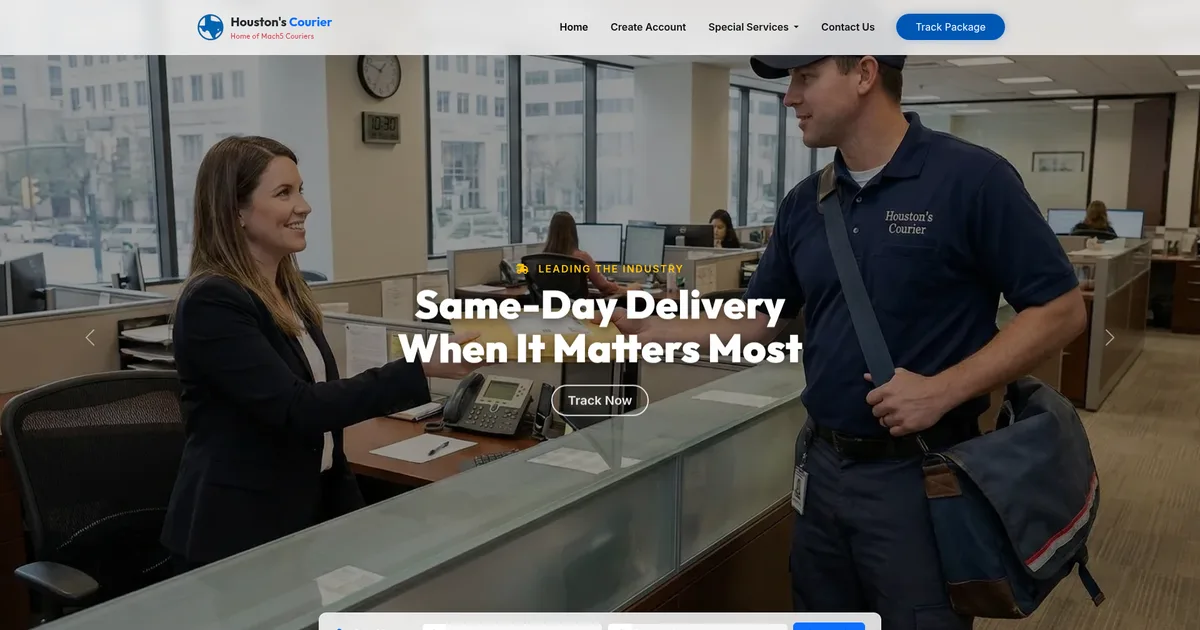
Houston's Courier has been moving freight and time-critical deliveries around the Gulf Coast for decades. Their website had fallen behind. This is what we rebuilt, what we surfaced, what we added, and what is still on the bench.
Starting with the part customers see
The old site was nearly a decade old. Its mobile layout was broken, with errors throughout that got worse the smaller the screen got. Underneath that, the site was thin where it counted: very little SEO foundation and almost no structured data, so search engines had to guess what the business did, where it operated and what services it offered.
The service list had also fallen behind. Houston's Courier kept adding capabilities while the website stayed the same, so work the company was actively selling was missing from the site.
The new site is a ground-up replacement: same-day delivery leads, the catalog reflects everything the company offers in 2026, structured data describes the business properly, and the client login sits on the homepage, where customers look for it.
One service the site was hiding, and one that is coming
A courier already sends a bonded, uniformed, background-checked person to a customer's door with a package. That position turns out to be worth more than a single delivery.
- Mobile notary: already offered, never advertised. Houston's Courier was already doing this work, and the old website left it out. Documents that need a notary are often the same documents that need a courier, so one visit covers both. The company earned none of the search traffic for it, because Google had no page to send anyone to.
- Electronic ID verification for age-restricted deliveries (18+ and 21+): built, launching with the new dispatch system. Alcohol, tobacco, vape and certain pharmacy items carry a legal obligation to verify age at handoff. This capability is new. It ships with the dispatch system described below, and customers can order it once that system goes live.
Those two are different kinds of work. One was a marketing gap with an easy fix: the service existed and the website needed to say so. The other required building something new, and it launches when the new system does.
The driver portal, where compliance happens
"We verify ID" is a claim. The driver portal, now in development, is the evidence. It is built for a phone in one hand and a package in the other:
- Barcode scanning off the air bill. Drivers scan with the phones they already carry. Scanning ends transposed tracking numbers, the most common cause of a package that is physically fine and administratively lost.
- Photo delivery confirmation. A timestamped photo at the drop point, attached to the stop. "It was left at the side door" stops being a memory and becomes a record.
- Electronic ID verification at handoff, over a secure network. Launching with the new system: the age check is performed and captured electronically at the point of delivery and sent over an encrypted connection, so the record exists the moment the package changes hands.
Each of these replaces something a driver used to remember with a record the system holds securely. That matters most on the day a client disputes a delivery: the answer is a record retrieved in seconds, even when the driver has made two hundred stops since.
Dispatch: replacing the whole system
The largest piece of this engagement is roughly two-thirds built. Here is what it replaces.
Dispatch, driver management, and the customer portal all lived inside one integrated legacy application on manage.houstonscourier.com. That coupling is the problem. Every change to how dispatchers work risked the customer-facing side, and every change a customer noticed had to be regression-tested against dispatch. Every improvement touched everything.
The replacement is a standalone system with three separate surfaces:
- Admin and dispatcher: order intake, assignment, and the live board dispatchers work from all day.
- Driver: the portal above, with scanning, photo confirmation and electronic ID capture.
- Client: built into the new website. Customers place and track orders on the same domain they landed on, in the same design as the rest of the site.
Three things ship with it:
- A suite of new security controls across all three surfaces. A system holding delivery addresses, signed proof of delivery and age-verification records holds sensitive data, and the new controls are designed around protecting it.
- A far easier experience end to end, from submitting an order to paying the invoice. The old flow worked for people who already knew it. The new one is clear to a first-time customer.
- Continuous route optimization using the current Google Maps Platform APIs, re-optimizing as the day changes. Houston traffic moves all day, and the route moves with it.
Splitting one application into three surfaces on a shared core costs more up front than restyling the old one. It buys the ability to change a dispatcher's workflow on a Tuesday without touching anything a customer can see.
No AI in the workflow, by design
In 2026 the default assumption runs the other way, so here it is plainly: people run the day-to-day operation of Houston's Courier. A real person handles every delivery ticket, every email, every phone call and every delivery.
The software's job here is to remove clerical work and to remember things accurately: scan a barcode, capture a photo, re-optimize a route as conditions change. The judgment calls stay with the dispatchers and drivers who know the accounts, the buildings, and which receiving dock opens at 7am.
For a same-day courier, that is the product. When a time-critical delivery goes wrong, the customer wants a person who can fix it.
What the search numbers did
A rebuild puts organic search at risk. New URLs, a new structure and a decade of accumulated signals all have to carry across, and sites often lose traffic in the move. Six months on, compared with the six months before:
- Impressions: 153K to 273K, up 78%
- Clicks: 3.05K to 3.84K, up 26%
Read those two together. Impressions grew faster than clicks because the site now surfaces for a far wider set of queries, including broader, higher-funnel searches that were previously out of reach and that convert at a lower rate by nature. Average click-through moved from about 2.0% to about 1.4% as a result. That is the arithmetic of a site appearing in many more places. The number that pays the bills, visits from search, rose by about 790 across the six months, roughly 130 more a month.
A good share of that is the unglamorous work: real structured data, a service catalog that lists the services, and pages for offerings like mobile notary that were previously invisible to search entirely.
Still to come
The dispatch and portal build is about two-thirds done. The remaining third is the part that has to be right first and fast second: moving live operations off the legacy system with every in-flight order intact, and moving the client portal into the new site so customers see one piece of software.
Age-restricted delivery goes live at the same time, with its own service page, once the system that performs it is carrying real traffic.
We will write that up when it ships, including whatever goes wrong on the way.
Houston's Courier is a Tuxxin LLC client. If your business runs on software a decade past its service life (you can usually tell, because everyone has a workaround for it), get in touch.